
As space was absorbed and consumed in movement by a spectator, a new architectonics was set in motion: a “picturesque revolution” that was born of setting sites in moving perspectives (…). The new sensibility engaged the physicality of the observer, challenging her ability to take in space and more space-a mobilized space.
During the eighteenth century, the production of travel discourse began to grow and took on a variety of forms, from literary to visual and spatial configurations. Journeys, poems, view paintings, and gardens views were among the new forms of shared spatiovisual pleasure. (…) the historian Alain Corbin writes: (…)The Italian veduta had learned to take a comprehensive view of their cities, and for ages tourists had rushed to take in the Bay of Naples from the terraces overlooking the city…The ‘prospect view’ offered a pleasure, combined with walking and the ideal day, that gave rise to a new way of seeing. Scanning sites and cityscapes, moving through and with landscapes, this opening of spatial horizons fashioned spectacular spectatorial pleasures. The “collective attraction for views” was another of the forces that shaped the cultural movement which proleptically led to the cinema. (…) Vedutismo was a particular incarnation of the observational gaze.(…) As they merged the codes of urban topography and landscape painting, city views also incorporated the cartographic drive, creating imaginative representational maps.
from Haptic Routes: View Painting and Garden Narratives

Carte du pays de Tendre 
M.me de Scudéry 1654
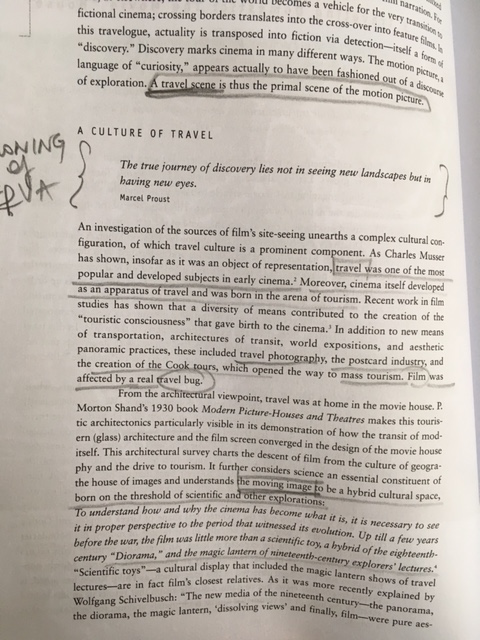
A culture of Travel


A Cartography of Emotions
“[…] When artists employ historical archives as media is history affected?
[…] Where does the body belong among the ubiquity of images?
The hypothesis – that the archive as artwork challenges the notion of history as a discourse based primarily upon chronology and documentation – no longer presupposes a stable and retroactive archive, but often a generative one. Consequently, the historicizing process of contemporary art is frequently mise-en-abyme (..)
from Introduction

Geography as a room of one’s own

“Taking Place”: from salon to Gardens
“ The location of art and archives in particular historical contexts and national histories brings to the forefront political dimensions of art in relation to life, technology and difference, and thus, social and political struggles involving class, ethnicity, gender, nationality, and colonialism, often at the center of utopian revolutions leading to various authoritarian and democratic regimes. In this struggle, more than a few twentieth-century Brazilian avant-gardes have enlisted the body centered metaphors of cannibalism, carnival and hunger in order to simultaneously incorporate the foreigner into the familiar and subvert cultural hierarchies that disregarded popular and folk forms of cultural expressions.
from Body-Centered Metaphors of Cannibalism, Carnival, and Hunger

Women’s travel writing
As the italian feminist critic Paola Melchiori , a passionate nomad, observes dislocation has always marked the terrain of the female traveler. Analyzing the literature of travel as a site of sexual difference, she writes: Reading women’s travel writing, one notices an absence of the past. Women who leave are not nostalgic. They desire what they have not had, and they look for it in the future. The desire does not take shape as “return” but rather as “voyage”. Nostalgia is substituted by dislocation*. Thinking as a voyageuse can trigger a relation to dwelling that is much more transitive than the fixity of oikos, and a cartography that is errant. Wandering defines this cartography, which is guided by a fundamental remapping of dwelling. A constant redrafting of sites, rather than the circularity of origin and return, ensures that spatial attachment does not become a desire to possess. In the words of Rosi Braidotti, “the nomad has a sharpened sense of territory but no possessiveness about it**”.
*Paola Melchiori, “Un sentimento senza oggetto”, Lapis no.19, September 1993, p.22
**Rosi Braidotti, Nomadic Subjects:Embodiment and Sexual Difference in Contemporary Feminist Thought, New York:Columbia University Press, 1994, pp.35-36
from Gender Nomadism: The Journey of Dwelling